
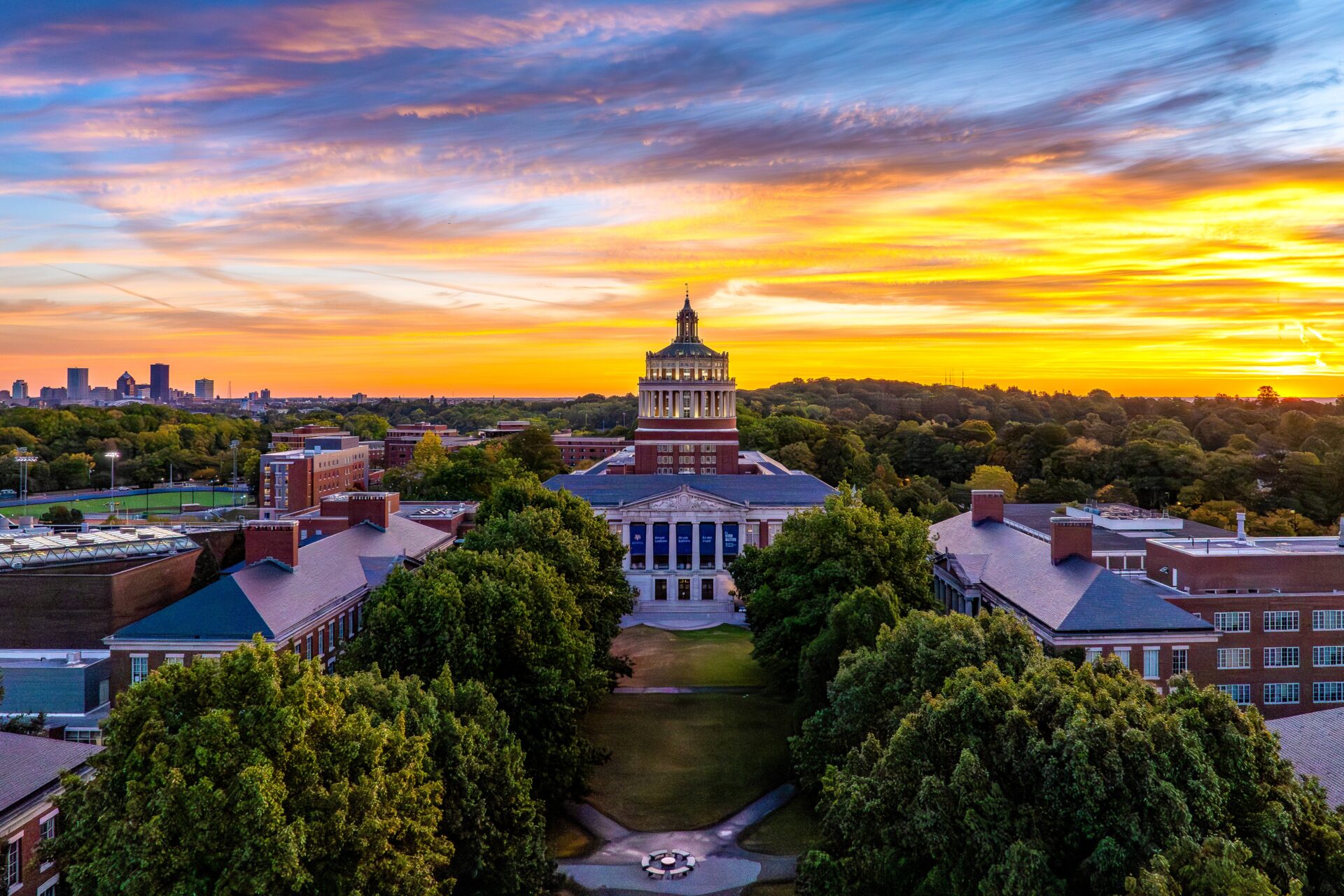
Being admitted to the University of Rochester is a big deal! We chose you for a reason — and we’re excited about what you’ll bring to our community.
As you finalize your college decisions, we want to assure you that the University of Rochester is the right place for you because you’re not just deciding where you’re going to spend the next four years. You’re deciding the environment you want to grow in. The environment where you’ll challenge yourself, build relationships, and ultimately figure out who you are. We hope URochester is that right place for you to continue your studies, the right place to grow as a person over the next four years, and the right place to build connections that will last beyond your time as a Yellowjacket. Some of our students share their URochester stories below.
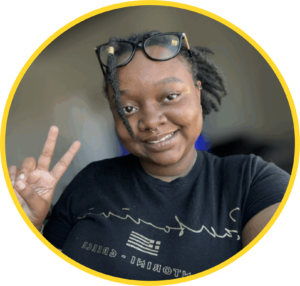 Hi, my name is Naima Petersen, and I am a senior here at the University of Rochester. I’m from New York City—specifically Manhattan. I’m double majoring in psychology and American Sign Language, and I’m a first-generation student with plans to pursue a PhD in clinical psychology.
For me, it’s kind of crazy to think that roughly three years ago, I was in your place, feeling both excited and nervous about this new college experience I was about to enter. At that time, I had already committed to the University of Rochester since I applied through Early Decision.
Why I picked URochester before URochester got to pick me.
From the moment I started my college process, I kept in mind which school would be the most affordable while still providing me with the full college experience I wanted. Keep in mind, I’m a first-generation college student, so most suggestions I received from family were based on what they had heard, not necessarily from research or personal experience.
I had about 10–15 schools on my list, and one of the first things I noticed about URochester was how easy their website was to navigate. I’m not sure about everyone else in the room, but college websites can be confusing—you end up finding everything except what you’re actually looking for. URochester knew what they wanted people to see about their school, and I noticed that. I saw the various programs, resources, and opportunities they offer and thought that was great.
But what really confirmed that I wanted to apply ED was when I visited campus for the first time. Once I started interacting with current students, meeting staff and faculty, and seeing how the campus was designed—how easy it was to get around—I fell in love with URochester. During that trip, I learned that URochester is a place where everyone strives to do their best and improve on their current best—not in a competitive environment, but in a collaborative one. And in my opinion, that’s the best of both worlds.
As I reflect on my time here so far, I can say that the reason I continue to choose URochester is the same reason I chose it in the first place—and that reason has only grown into a million more. Opportunities like being part of the McNair Scholars Program, the friends I’ve made and continue to make, and even the small things—like how beautiful this campus looks throughout the fall. I never fail to capture a sunset, double rainbows, or even the first snowfall of the year. URochester is the place for me, and I hope it can be your place too.
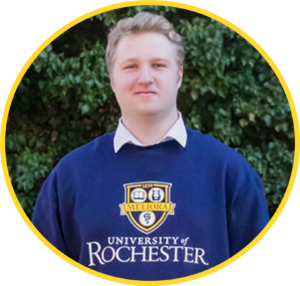
My name is Elijah Bader-Gregory. I’m a senior here at the University of Rochester, originally from Buffalo, New York. I’m studying Economics and Political Science, with minors in Philosophy and Business.
I remember exactly what this moment felt like. When I was in your position, I wasn’t looking for a place that had everything figured out for me. I didn’t want a cookie-cutter experience. I didn’t want to be locked into a single path, a single identity, or a narrow definition of success at 18 years old. What drew me to URochester was the opposite. It was the freedom.
The freedom to explore disciplines. The freedom to change direction. The freedom to follow questions instead of just checking boxes and reading textbooks. And I didn’t fully understand how valuable that was at the time, but looking back now, four years later, I can say that it’s been the most important part of my experience. That freedom is real here, and it’s intentional.
Rochester is a place with a long history of people asking big questions and pushing boundaries. It’s where Frederick Douglass published The North Star, challenging the country to rethink freedom and justice. It’s where Susan B. Anthony organized, questioning systems people assumed couldn’t change. It’s where George Eastman and the Eastman Kodak Company transformed how people see the world.
There’s a through line here in the history of our shared community.
We care about this community, and we expect ourselves to ask better questions. To be curious. To engage deeply with the world around us.
For me, that’s shown up in how I’ve built my education. I came in interested in politics, thinking about institutions, public policy, and leadership as a whole. Then I got pulled into economics, trying to understand systems, incentives, and how decisions actually play out in the real world.
And along the way, I found myself wanting more tools to think about ethics, about decision-making, about impact, so I added minors in business and philosophy. And URochester allowed me to do that; it allowed me to connect all of those perspectives. Not just in theory, but in practice. Through research. Through leadership. Through experiences that push me to think about how ideas actually translate into impact. That’s what makes this place different.
One of the most formative parts of my college experience was in student government, where I served as a first-year senator, then vice president as a sophomore, and eventually president of the student body my junior year. This experience gave me the tools and opportunity to have been able to advocate for fellow students and work on real institutional decisions.
I’ve also been an RA, living with and supporting first-year students as they navigate the exact transition you’re about to go through – And honestly, getting to watch that growth happen in real time has been one of the most meaningful parts of my experience here.
I’ve also had the chance to work several jobs on campus and be involved in research experiences that have pushed me to apply what I’m learning in real time. And I’ll be honest, all of these experiences have taught me just as much, if not more, than some of my classes, and I’m so thankful that URochester has provided me with this holistic experience. That’s what experiential learning looks like.
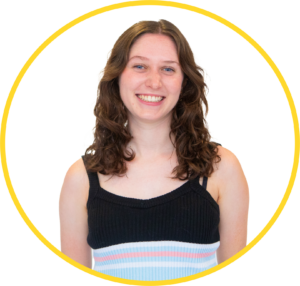
My name is Sammy Bauer and I am a senior here at the University of Rochester, about to graduate with a Bachelor of Arts in Psychology, and Bachelor of Science in Brain and Cognitive Sciences and a minor in dance.
When I was looking for a school, of course one thing I was interested in was the academics. Here at URochester, you’re not just given a list of classes that you may or may not be interested in to check off the list, but you get to build your own curriculum that reflects your passions and long-term goals. The cluster system has allowed me to spend the majority of my time here really focusing in on how we as humans develop, think and function throughout our everyday lives. I’ve done this all without having to give up one of my other passions, dance.
Our curriculum holds so much flexibility for you to take charge of your own learning and education, but that doesn’t just stop with the classroom. Experiential learning opportunities have been some of the most meaningful experiences I’ve had here. From spending a semester studying themes of consciousness in Copenhagen to having my own poster at an international research conference, I have learned just as much outside of the classroom as I have inside of it.
The best part about URochester is the community that I’ve gotten to do all of these things in.
We are a community of curious minds. Of passionate learners. And a community committed to Meliora; to making ourselves, our campus community and beyond Ever Better.
We are also committed as a school to being a collaborative environment as opposed to a more competitive one. That was one of the main things I was looking for in a school: an academic community that would encourage me to be the very best student I could, without feeling like I am in a constant competition with my peers.
I am happy to say I have found an environment of older students willing to give advice on what classes I should take and classmates that are less interested in judging me for what grade I got and more focused on collaboration.
The passion that our student body has doesn’t stop with our academics but expands into extracurricular activities as well. We have more than 270 active student organizations that allow us to continue to build up our campus community and meet people that we may not have gotten the chance to in the classroom.
I have gotten to dance with students ranging from engineering to history majors in Ballet Performance Group, made connections to children in the Rochester City School district while volunteering with Partners in Reading and have even gotten to learn the basics of a cappella in Trebellious workshop. With over 90% of our campus being involved in our student organizations, extracurricular activities are a huge part of life on campus, and make our already passionate students in the classroom even more passionate and well-rounded human beings.
My experiences here from building my own curriculum to joining student organizations have shaped me into the person I am today. I’ve learned what it means to be a leader, to be a part of someone’s support system, and what it is like to really be a part of and contribute to a community, and for that I am forever grateful for my time here.
 My name is Zoe Stanley. I’m a junior here at the University of Rochester, originally from New York City. I’m studying Cell Biology and Spanish, with the
eventual goal of medical school.
And sitting where you are right now doesn’t feel that long ago for me. I remember exactly what that moment felt like. I had worked incredibly hard to get there. I had options. And I was being asked to make a decision that felt exciting—but also overwhelming.
When I was in your position, I was looking for a true community. I wanted to be
surrounded by people that are rooting for my success, not trying to compete
against me. I wanted to have friends with the same goals as me, that see me as
a support rather than an opponent.
I also wanted to study at a top-tier research school, but more than anything, I
wanted to work with faculty who love teaching and mentoring. I wanted my
professors to understand that teaching is a critical part of the research process,
rather than a side effect. I wanted my mentors to help me ask my own questions,
and show me how to answer them.
At URochester, there’s a willingness to challenge ideas. To think critically. To work together to make a difference.
And that same spirit shows up here on campus. We collaborate every day to
break barriers. To be curious. To engage deeply with the world around us, and
support each other while doing it. For me, that means pursuing a degree in the humanities, as a student that at any other school would be caged into the natural sciences. That flexibility has supported me in my goals, even though many institutions would declare
Spanish degree to be too different from biology. Working with Spanish-speaking
patients in my clinical work reminds me how lucky I am to be at a university that
not only allows but encourages different approaches to academics.
Here at URochester, you don’t just pick a major or a degree. You build an
education inside and outside the lecture hall that reflects how you think—and this
education empowers you in real time to make a difference.
URochester has given me the opportunity to be involved in so much. I arrived at
college interested in research, wanting to spend my time in the lab and at a
microscope. My mentors nurtured that interest, but also encouraged me to explore the clinical aspects of research. That research in our Emergency Department exposed me to the community surrounding me, and pushed me to pursue medicine. Due to that mentorship, I now work on neurosurgery-focused clinical trials.
I also engaged directly with classes I never realized I would be interested in.
When I adored my chemistry classes, I became a workshop leader in that
department, directly mentoring my peers and working with professors to help the
classes after me succeed. I became a tutor, returning to my organic chemistry
notes to draw connections between different reactions. I took advantage of these
resources myself, making friends with workshop leaders that served as my
mentors, and learning from them to better myself.